
Why Hip Strength Matters: The Foundation of Better Movement
- Section 1: Understanding the Hip Complex
- Section 2: How Hip Strength Influences Posture
- Section 3: Hip Strength and Walking Mechanics (Gait)
- Section 4: Hip Strength and Injury Prevention
- Section 5: The Research Behind Hip Strength
- Section 6: Signs Your Hips May Be Weak
- Section 7: Practical Ways to Improve Hip Strength
- Section 8: Lifestyle Habits That Support Healthy Hips
- Frequently Asked Questions
- Key Takeaways
- References
If you had to name the muscles that matter most for how you move through your day, would the hips make your list? For most people, the answer is no. We think about our backs when they ache, our knees when they click, and our shoulders when we can't reach the top shelf. The hips, sitting quietly at the center of the body, rarely get credit for the work they do — until something goes wrong.
That's a problem, because the hips are arguably the single most influential region in the entire kinetic chain. They connect your upper body to your lower body, they absorb and transfer force with every step, and they stabilize your pelvis every single time one foot leaves the ground. Standing up from a chair, climbing stairs, carrying groceries, jogging around the block, catching your balance on an uneven sidewalk — none of it happens without your hips doing quiet, constant work.
This article takes a close look at why hip strength deserves far more attention than it usually gets. We'll walk through the anatomy of the hip complex, explain how hip strength shapes posture and gait, summarize what the research says about hip strength and common injuries, and give you a practical, evidence-informed toolkit for building stronger, more resilient hips — whether you sit at a desk all day, spend your weekends running trails, or simply want to move well for the rest of your life.
Section 1: Understanding the Hip Complex
A ball-and-socket joint built for movement in every direction
The hip is a ball-and-socket joint, which means the rounded head of the femur (thigh bone) sits inside a cup-shaped socket in the pelvis called the acetabulum. This design is what allows the hip to move in nearly every direction — forward and back, side to side, and rotating inward and outward — while still bearing enormous amounts of load. Compare this to the knee, which mostly bends and straightens like a hinge. The hip's versatility is exactly why it plays such a central role in everyday movement: it has to coordinate motion in three dimensions, not just one.
The bones involved are straightforward: the femur on the leg side, and the pelvis — made up of the ilium, ischium, and pubis — on the trunk side. Where those two bones meet is surrounded by a network of muscles, ligaments, and connective tissue that gives the joint both mobility and stability at the same time. That balance between "moves freely" and "stays stable" is the whole story of hip function, and it's why hip muscles matter so much.
The major muscles of the hip complex
Gluteus maximus is the largest and most powerful muscle in the body. It's the primary hip extensor, meaning it's responsible for driving the leg backward — the motion that powers you up a flight of stairs, out of a chair, or into a sprint. It also plays a supporting role in stabilizing the pelvis and controlling hip rotation.
Gluteus medius, located on the side of the hip, is the primary hip abductor. Its job is to keep the pelvis level whenever you're standing on one leg — which, as we'll cover in the walking mechanics section, is most of the time you spend walking. Weakness here shows up more than almost any other muscle in this article, because so many common movement problems trace back to it.
Gluteus minimus sits underneath the gluteus medius and works alongside it to stabilize the pelvis during single-leg movement.
Deep external rotators — a group of six small muscles including the piriformis — sit deep beneath the glutes and control rotation of the femur within the hip socket. They're small, but they play an outsized role in keeping the knee and hip aligned during activities like squatting, lunging, and cutting movements in sport.
Hip flexors, primarily the iliopsoas group, lift the thigh toward the torso. They're essential for walking, running, and climbing, but they're also the muscle group most likely to become short and tight from prolonged sitting — a theme we'll return to.
Adductors, the inner-thigh muscles, draw the leg toward the midline of the body and provide stability during side-to-side movement and single-leg activities.
Hamstrings, though often thought of as knee muscles, cross the hip joint too and contribute to hip extension, especially during running and lifting.
How these muscles work together
No single hip muscle works in isolation. During walking, for example, the glute max drives you forward while the glute medius and minimus simultaneously stabilize your pelvis so it doesn't tilt with every step. During a squat or a lift, the glutes, deep rotators, and adductors coordinate to keep your knees tracking properly over your feet. This coordinated teamwork — rather than any one muscle acting alone — is what allows the hips to function as the body's central load-transfer station, moving force efficiently between your upper body, spine, and legs.
Section 2: How Hip Strength Influences Posture
Understanding pelvic alignment
Good posture starts lower than most people think. The pelvis sits at the base of the spine, and its position directly shapes the curve of your lower back. When the pelvis is in a neutral position — neither tipped too far forward nor tucked too far under — the lumbar spine sits in a natural, gently curved alignment that distributes load evenly.
Two common deviations from neutral are worth understanding:
- Anterior pelvic tilt occurs when the front of the pelvis drops and the back rises, exaggerating the lower back's curve. This is often associated with tight, overactive hip flexors paired with underactive glutes.
- Posterior pelvic tilt is the opposite pattern — the pelvis tucks under, flattening the natural curve of the lumbar spine. This is frequently seen in people who sit for long periods with a slouched lower back.
Neither position is inherently "wrong" in a brief moment, and posture is more dynamic and individual than older, rigid models suggested. But when the pelvis sits consistently and rigidly in one of these positions, day after day, the muscles around it adapt: some become chronically shortened, others become chronically lengthened and weak. Over time, this imbalance can change how load moves through the lumbar spine and hips.
The gluteal–low back connection
The glutes, particularly the gluteus maximus and gluteus medius, act as key stabilizers of the pelvis. When they're strong and responsive, they help control the tilt of the pelvis and share the workload of stabilizing the trunk with the deep core and spinal muscles. When they're weak, other structures — often the lower back muscles — have to work harder to compensate, and the lumbar spine can end up absorbing more mechanical stress than it's designed for.
This is one reason clinicians frequently include gluteal strengthening in low back pain rehabilitation programs. Research has found a meaningful correlation between low back pain and gluteal muscle dysfunction, with reduced gluteus medius strength during abduction being one of the associated functional changes. Multiple trials have tested this connection directly: a randomized controlled trial of gluteus maximus–focused strengthening in adults with chronic mechanical low back pain found that chronic low back pain is frequently associated with poor neuromuscular control and reduced gluteus maximus activation, and an eight-week structured glute program improved gluteus maximus strength in this population, reinforcing the idea that the hip and low back function as a connected system rather than two separate regions.
Hip stability during standing
Standing might feel passive, but it's an active balancing act. Your hip muscles are constantly making tiny adjustments to keep your pelvis and trunk centered over your feet. When hip strength and endurance are adequate, this happens efficiently and without conscious effort. When hip muscles fatigue or are chronically weak, people often shift their weight onto one leg, lean on structures like the joint capsule instead of muscle, or develop compensatory patterns elsewhere in the spine — habits that can contribute to discomfort over the course of a long day on your feet.
The effect of prolonged sitting
For office workers and anyone with a desk-bound routine, sitting deserves special mention. Prolonged hip flexion — the position your hips are in while seated — tends to shorten and tighten the hip flexors over time, while the glutes, which are largely inactive while sitting, can become underused and comparatively weaker. This combination — tight hip flexors paired with underactive glutes — is one of the more consistent patterns seen in people who sit for the majority of their day, and it's a major reason posture-focused programs emphasize breaking up sitting time and actively training the glutes, not just stretching the front of the hip.
Section 3: Hip Strength and Walking Mechanics (Gait)
The phases of walking
A normal walking cycle, or gait cycle, is divided into two broad phases: stance phase, when your foot is in contact with the ground, and swing phase, when that same leg is moving through the air to take the next step. Stance phase makes up roughly 60% of the gait cycle, and for a significant portion of that time, only one foot is touching the ground — a period known as single-leg stance.
Why single-leg stance is where hip strength matters most
Every time you're in single-leg stance — which happens dozens of times per minute while walking — your entire body weight rests on one hip joint, and there's no second leg to help balance the load. The gluteus medius is critically important during the stance phase of the gait cycle for keeping both hips level, and during stance, approximately three times body weight is transmitted through the hip joint, with the hip abductors' action accounting for roughly two-thirds of that load. In other words, your gluteus medius isn't just helping you walk — it's doing heavy mechanical work with every single step, on both legs, thousands of times a day.
What happens when the gluteus medius is weak: Trendelenburg gait
When the gluteus medius and minimus can't adequately stabilize the pelvis during single-leg stance, the opposite side of the pelvis drops instead of staying level. This drooping of the pelvis to the contralateral side during walking is known as a Trendelenburg gait, named after the German surgeon Friedrich Trendelenburg, who first described the related clinical test in 1895. Some people compensate by leaning their upper body toward the weak-hip side, which reduces the pelvic drop but creates its own inefficient, asymmetrical walking pattern. This pattern of lateral pelvic drop and gait asymmetry has also been linked to overuse injuries such as iliotibial band syndrome, patellofemoral pain, and lumbar strain — a direct example of how a hip weakness can ripple outward to affect the knee, the low back, and beyond.
Hip drop, energy transfer, and walking efficiency
Even short of a clinically obvious Trendelenburg gait, subtler degrees of "hip drop" are common and can quietly reduce walking efficiency. When the pelvis isn't well-stabilized, the body has to make small compensatory movements with each step — extra trunk lean, altered stride length, or changes in how force moves up through the leg — all of which cost energy. Efficient gait depends on the hips absorbing ground reaction forces and transferring them smoothly through the pelvis and spine; when that transfer is disrupted, the effect can be felt as fatigue during longer walks, altered stride patterns, or compensatory discomfort in the knees, low back, or feet.
Running mechanics
The same principles apply — magnified — during running, where ground reaction forces are considerably higher and single-leg stance time is compressed into a shorter, more forceful window. Hip stability during the stance phase of running influences how the knee and lower leg track, which is why so much of the research on running injuries (covered in the next section) centers on hip strength and control rather than the knee or foot in isolation.
Section 4: Hip Strength and Injury Prevention
Hip weakness doesn't just affect the hip itself. Because the hip sits at the crossroads of the lower body's kinetic chain, insufficient strength or control here can alter mechanics at the knee, lower leg, foot, and spine. Below is a look at the biomechanical reasoning — not just a list — behind several common injuries linked to hip weakness.
Patellofemoral pain syndrome (runner's knee)
Patellofemoral pain — pain around or behind the kneecap — was traditionally treated by focusing exclusively on the quadriceps. Research over the past two decades has shifted that thinking. When the hip abductors and external rotators are weak, the thigh bone tends to drift into excessive internal rotation and adduction during weight-bearing activities like walking, squatting, or descending stairs. This subtly changes the angle at which the kneecap tracks within its groove, increasing stress on the patellofemoral joint. Strengthening the hip muscles helps control this rotation and adduction at the source, rather than only addressing the symptom at the knee.
IT band syndrome
The iliotibial (IT) band is a thick strip of connective tissue running along the outside of the thigh from the hip to just below the knee. IT band syndrome, common in runners, has been linked to altered hip mechanics during running — particularly excess hip adduction (the thigh drifting inward) during the stance phase. Meta-analyses of running biomechanics have found strong evidence of higher peak knee internal rotation and greater peak hip adduction in runners with iliotibial band syndrome compared with uninjured runners. The proposed mechanism is that when the hip abductors can't adequately control the thigh's inward drift, the IT band experiences increased friction and tension against the outside of the knee with every stride.
ACL injury risk
Non-contact ACL injuries — common in sports involving cutting, pivoting, and landing — are influenced by a movement pattern called dynamic knee valgus, where the knee collapses inward during landing or deceleration. Hip abductor weakness is a contributing factor to this dynamic valgus biomechanics at the knee, and this neuromuscular imbalance is thought to increase stress placed on the ACL during high-demand movements. This is one reason ACL injury-prevention programs place such heavy emphasis on hip and trunk control, alongside landing mechanics, rather than knee-focused training alone.
Lower back pain
As discussed in Section 2, weak glutes are associated with altered lumbopelvic mechanics and greater reliance on the lower back musculature and passive spinal structures to control movement and stability. This connection isn't just theoretical — multiple trials have tested whether restoring gluteal strength improves low back pain outcomes, with findings summarized further in Section 5.
Hip pain and greater trochanteric pain syndrome
Weakness or dysfunction of the gluteus medius and minimus tendons themselves is a recognized contributor to lateral hip pain, sometimes called greater trochanteric pain syndrome. Because these muscles are working constantly during standing and walking, chronic overload or degeneration of their tendons can become a persistent source of discomfort on the outside of the hip.
Hamstring injuries
The hamstrings cross both the hip and the knee, and they work closely with the glutes during hip extension movements like sprinting. When the glutes are underactive, the hamstrings and lower back can be forced to take on a larger share of hip-extension work than they're built for, a pattern some clinicians associate with increased hamstring strain risk during high-speed activities like sprinting.
Achilles problems and plantar fasciitis
The connection here is less direct but still meaningful: altered hip and pelvic control changes how force travels down through the leg during gait and running, including how the foot and ankle absorb load at push-off. When hip mechanics are inefficient, the lower leg and foot may end up compensating for instability higher up the chain, which some clinicians consider a contributing factor in certain overuse presentations at the Achilles tendon and plantar fascia — though this relationship is less thoroughly studied than the hip-knee connections above.
Falls in older adults
For older adults, hip strength — especially of the hip abductors — has a particularly direct and well-documented relationship with fall risk, which we'll explore further in the next section.
Section 5: The Research Behind Hip Strength
This section summarizes some of the higher-quality evidence — systematic reviews, meta-analyses, and randomized controlled trials — examining hip strength across several movement-health outcomes.
Hip strengthening and knee pain
A widely cited systematic review with meta-analysis pooling 14 randomized and controlled trials involving 673 participants with patellofemoral pain found that combined hip and knee strengthening decreased pain (mean difference of −3.3 on a 0–10 scale) and improved activity levels compared with no training or placebo, and that this combined approach was more effective than knee strengthening alone. A more recent 2025 systematic review and meta-analysis reached a similar conclusion, comparing hip-and-knee strengthening against knee-strengthening-only protocols in patients with patellofemoral pain syndrome, following PRISMA guidelines across multiple databases. Earlier randomized trials specifically testing hip strengthening in women with patellofemoral pain also demonstrated improvements that were maintained over longer follow-up periods, supporting hip strengthening as a durable, not just short-term, intervention.
Hip strengthening and lower back pain
A broader systematic review with meta-analysis and GRADE quality ratings, examining hip strengthening across musculoskeletal conditions of the trunk and lower limbs, found short-term effects of hip strengthening on both pain intensity and hip strength in patellofemoral pain when compared with no intervention, and uncertain evidence that hip strengthening enhanced the short-term effects of other active interventions on pain intensity and disability in low back pain (de F. Silva et al., 2022). It's worth noting the certainty of this evidence was rated low to very low by the review's own GRADE assessment — a reminder that "promising" is not the same as "proven," and that hip strengthening is best understood as one useful tool within a broader low back pain management approach rather than a standalone cure. Other trials have reported more directly positive findings: a randomized controlled trial found that adding hip strengthening exercises to a lumbopelvic exercise programme improved outcomes for people with non-specific low back pain, and a systematic review specifically concluded that hip muscle strengthening exercises can reduce pain and disability in patients with non-specific low back pain.
Hip strength and running injuries
Systematic reviews of runners with iliotibial band syndrome have consistently examined hip abductor strength as a contributing factor. A systematic review and meta-analysis found that female runners with current iliotibial band syndrome exhibited smaller peak hip internal rotation angles and lower isometric hip abductor strength compared with uninjured controls, though risk factors appeared to differ between female and male runners and according to injury status. This nuance matters: not every runner with IT band syndrome has measurably weak hips, which is why individualized assessment — rather than a one-size-fits-all strengthening prescription — tends to produce the best outcomes.
Hip strength and balance
The relationship between hip abductor strength and balance control is well established in the biomechanics literature. Because the gluteus medius and minimus are the primary muscles resisting sideways falls during single-leg stance and gait, their strength is directly tied to lateral, or side-to-side, balance control — one of the balance directions most strongly associated with fall risk in older adults.
Hip strength in older adults
This is one of the better-supported areas of the hip-strength literature. A diagnostic accuracy study found that hip abductor maximum voluntary isometric strength and rate of force generation were useful, well-calibrated predictors for identifying older adults at risk of falls, alongside more established tools like the Short Physical Performance Battery and Timed Up and Go test. Related research has found that compared with non-fallers, older adults with a history of falls tend to have increased fatty infiltration in their hip abductor muscles and decreased hip abductor strength, with a high degree of abductor fat correlating with greater gait variability and fall risk. On the intervention side, a systematic review and meta-analysis of power training — a specific form of resistance training emphasizing speed of force production — found that this type of training increased functional capacity related to fall risk beyond what was achieved with other types of exercise in older adults. More broadly, a recent systematic review of 27 randomized controlled trials found that structured exercise interventions — including multimodal strength-and-balance training — were associated with fall reductions in the range of roughly 20 to 45%, alongside meaningful gains in lower-limb strength and functional performance in community-dwelling older adults.
Hip strengthening for athletes
In sport, the clearest evidence connects hip and trunk neuromuscular control to ACL injury prevention. A systematic review and meta-analysis of neuromuscular training programs for young female athletes found that well-controlled neuromuscular training — which typically combines strength training, plyometrics, balance work, and proximal (hip and trunk) control — reduces the risk of ACL injury by roughly 50% in female athletes. Because female athletes face a substantially higher rate of ACL injury than male athletes in comparable sports, this body of research has had a significant influence on how strength and conditioning programs are designed for young athletes across many sports.
Section 6: Signs Your Hips May Be Weak
The following are potential indicators of hip weakness that people commonly notice — not a diagnostic checklist, and not proof of a specific condition. If several of these sound familiar, it may be worth having your movement assessed by a physical therapist or qualified movement professional.
- Difficulty standing on one leg for 20–30 seconds without wobbling or your pelvis dropping
- Knees collapsing inward during squats, lunges, or stepping down from a curb
- Poor balance, especially on uneven surfaces or when your vision or attention is occupied
- A visible hip drop or "waddle" during walking, sometimes more noticeable to others than to yourself
- Recurrent or nagging knee pain, particularly around or behind the kneecap
- Lower back discomfort that tends to build over the course of standing or walking
- Poor squat mechanics, such as the knees caving in or the torso collapsing forward
- Difficulty or discomfort climbing stairs, especially leading with one particular leg
- Fatigue during walking that seems disproportionate to the distance covered
Again — these are signals worth paying attention to, not a self-diagnosis tool. Many of them can also stem from other causes, including joint issues, nerve involvement, or simple deconditioning. A qualified professional can help sort out what's actually driving your symptoms.
Section 7: Practical Ways to Improve Hip Strength
Below are evidence-informed exercises commonly used in both rehabilitation and general strength programs. Move through beginner progressions first, and only advance once you can perform the current version with good control and without pain.
Glute Bridge
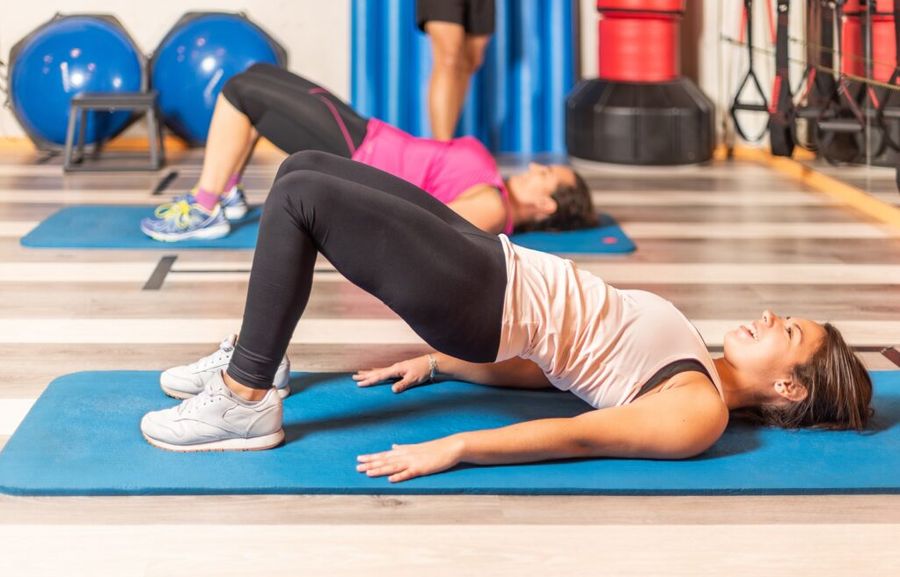
Purpose: Builds foundational gluteus maximus strength and teaches hip extension without compensating through the lower back. Primary muscles: Gluteus maximus, hamstrings. Why it helps: It's one of the most accessible ways to activate the glutes directly, making it a strong starting point for anyone who's been sitting most of the day. Common mistakes: Overarching the lower back instead of driving through the glutes; letting the knees splay outward. Beginner progression: Lie on your back, knees bent, feet flat. Squeeze your glutes and lift your hips until your body forms a straight line from shoulders to knees; lower with control. Advanced progression: Single-leg glute bridge, or add a resistance band around the knees to challenge stability.
Single-Leg Bridge
Purpose: Adds a unilateral (single-leg) stability demand to the standard bridge. Primary muscles: Gluteus maximus, gluteus medius, hamstrings. Why it helps: Because so much of daily movement happens on one leg at a time, unilateral exercises transfer more directly to real-world function than two-legged versions. Common mistakes: Letting the hips rotate or drop toward the non-working side. Beginner progression: Master the two-legged bridge first, then lift one foot off the floor at the top of the movement. Advanced progression: Perform the full single-leg bridge through a complete range of motion, or elevate the working foot on a low step.
Clamshell
Purpose: Isolates the gluteus medius and deep external rotators in a low-load, controlled position. Primary muscles: Gluteus medius, gluteus minimus, deep external rotators. Why it helps: It's a gentle entry point for waking up muscles that are often underactive after prolonged sitting, before progressing to more demanding, weight-bearing exercises. Common mistakes: Rolling the hips backward to "cheat" the movement instead of rotating from the hip. Beginner progression: Lie on your side, knees bent, feet together; keeping hips stacked, lift the top knee like an opening clamshell. Advanced progression: Add a resistance band above the knees, or perform in a "hip-hinged" side-lying position for greater range of motion.
Side-Lying Hip Abduction
Purpose: Directly strengthens the gluteus medius in its primary abduction role. Primary muscles: Gluteus medius, gluteus minimus, tensor fasciae latae. Why it helps: This is one of the more direct ways to build the exact muscle action responsible for keeping your pelvis level during single-leg stance in walking. Common mistakes: Rotating the leg forward (using the hip flexor) instead of lifting straight out to the side. Beginner progression: Lie on your side, bottom leg bent for stability, top leg straight; lift the top leg toward the ceiling, keeping the hip stacked. Advanced progression: Add ankle weights or a resistance band, or perform standing against a cable/band for a more functional loading angle.
Monster Walks
Purpose: Builds hip abductor strength and endurance in a dynamic, weight-bearing pattern. Primary muscles: Gluteus medius, gluteus minimus. Why it helps: Because it's performed standing and moving, it more closely mirrors how these muscles need to work during actual walking and athletic movement. Common mistakes: Standing too upright; letting the knees drift inward instead of pressing outward against the band. Beginner progression: Place a light resistance band above the knees, assume a partial squat, and step diagonally forward and out to each side. Advanced progression: Move the band down to the ankles for a greater lever arm and demand.
Lateral Band Walks
Purpose: Similar to monster walks, with a purely side-to-side movement pattern. Primary muscles: Gluteus medius, gluteus minimus. Why it helps: Trains the hip abductors through continuous tension, which builds the kind of sustained control needed during longer walks or runs. Common mistakes: Taking steps that are too large, causing the knees to collapse inward; letting the band go slack between steps. Beginner progression: Light band above the knees, small controlled side steps, staying in a partial squat throughout. Advanced progression: Move the band to the ankles and increase resistance or step distance.
Step-Ups
Purpose: Builds single-leg strength and control through a functional, everyday movement pattern. Primary muscles: Gluteus maximus, gluteus medius, quadriceps. Why it helps: Step-ups closely mimic stair climbing, making them one of the most directly transferable exercises on this list. Common mistakes: Pushing off with the trailing leg instead of driving up through the working leg; letting the working knee cave inward. Beginner progression: Use a low step or box, controlling both the upward and downward phases. Advanced progression: Increase step height, add dumbbells, or slow the descent to increase time under tension.
Bulgarian Split Squat
Purpose: A more demanding single-leg strength exercise that heavily loads the hip and thigh of the front leg. Primary muscles: Gluteus maximus, gluteus medius, quadriceps. Why it helps: Builds significant single-leg strength and stability, which supports everything from walking on uneven terrain to more demanding athletic movements. Common mistakes: Placing the rear foot too close, which shifts load excessively onto the knee rather than the hip; letting the front knee track inward. Beginner progression: Bodyweight only, rear foot on a low support, focusing on control through a comfortable range. Advanced progression: Add dumbbells or a barbell, and increase depth as mobility and strength allow.
Romanian Deadlift
Purpose: Trains hip-hinge mechanics and strengthens the posterior chain — glutes and hamstrings together. Primary muscles: Gluteus maximus, hamstrings. Why it helps: Teaches the body to generate power from the hips rather than the lower back, a pattern that carries over to lifting objects safely in daily life. Common mistakes: Rounding the lower back instead of hinging at the hips; bending the knees too much, turning it into a squat. Beginner progression: Light dumbbells or a broomstick, focusing purely on the hip-hinge pattern with a flat back. Advanced progression: Increase load with a barbell or heavier dumbbells as hip-hinge technique becomes consistent.
Single-Leg Romanian Deadlift
Purpose: Combines the hip-hinge pattern with single-leg balance and stability demands. Primary muscles: Gluteus maximus, gluteus medius, hamstrings. Why it helps: Because it challenges balance and strength simultaneously, it closely mirrors the demands of walking and running. Common mistakes: Letting the hips rotate open instead of staying square to the floor; sacrificing range of motion for balance. Beginner progression: Perform bodyweight only, holding onto a wall or chair for balance as needed. Advanced progression: Add a light dumbbell in the opposite hand, removing external balance support.
Hip Airplanes
Purpose: An advanced single-leg exercise that trains rotational hip control. Primary muscles: Gluteus medius, gluteus minimus, deep external rotators. Why it helps: Builds the kind of rotational hip stability that's especially valuable for cutting, pivoting, and changing direction in sport. Common mistakes: Losing balance and compensating through the trunk rather than controlling the movement through the hip. Beginner progression: Small controlled rotations while holding onto a support. Advanced progression: Full range rotation without support, performed slowly and with control.
Copenhagen Plank
Purpose: A demanding adductor-strengthening exercise increasingly used in injury-prevention programs, especially for athletes in cutting and change-of-direction sports. Primary muscles: Adductors, with secondary involvement of the obliques and hip stabilizers. Why it helps: Adductor strength complements abductor strength, supporting balanced hip control from both sides of the joint. Common mistakes: Attempting the full version before building a base level of strength, often resulting in poor form or strain. Beginner progression: A bent-knee, short-lever version with the top leg supported on a bench, bottom knee bent. Advanced progression: Full straight-leg Copenhagen plank with the top leg fully extended on the bench.
Single-Leg Balance
Purpose: Trains the neuromuscular control that underlies hip stability, independent of raw strength. Primary muscles: Gluteus medius, gluteus minimus, deep stabilizers of the foot and ankle. Why it helps: Strength alone isn't enough if the nervous system can't coordinate it quickly; balance work builds that coordination directly, which is part of why it's such a consistent feature of fall-prevention programs for older adults. Common mistakes: Relying on the eyes and arms too heavily instead of challenging the hip stabilizers to do the work. Beginner progression: Stand on one leg near a wall or counter for support, working up to 20–30 seconds. Advanced progression: Close your eyes, stand on an unstable surface like a pillow or foam pad, or add gentle arm and leg movements while balancing.
Section 8: Lifestyle Habits That Support Healthy Hips
Exercise alone isn't the whole picture. A few daily habits meaningfully support long-term hip health:
- Break up prolonged sitting. Standing, walking, or simply changing position every 30–60 minutes helps counteract the tight-hip-flexor, underactive-glute pattern associated with long sitting periods.
- Walk regularly. Walking is a low-impact way to keep the hip muscles engaged and coordinated throughout the day, and it complements — though doesn't replace — dedicated strength work.
- Prioritize daily mobility. A few minutes of hip-focused mobility work can help maintain the range of motion needed for the exercises above and for everyday movement.
- Progress your strength training gradually. Consistent, progressive strengthening — gradually increasing resistance, range, or difficulty over time — tends to outperform sporadic, high-intensity efforts.
- Support recovery with sleep. Muscle adaptation happens during recovery, not just during the workout itself, making consistent sleep a genuine part of a strength-training plan.
- Pay attention to nutrition and body weight. Adequate protein intake supports muscle maintenance and growth, and body weight influences the mechanical load your hips manage throughout the day.
- Choose supportive, appropriate footwear. Footwear affects how forces travel up through the leg and can influence hip and gait mechanics, particularly during walking and running.
- Include balance training. As discussed in Section 5, balance training is a well-supported, standalone contributor to fall-risk reduction, particularly for older adults, and pairs naturally with hip-strengthening work.
Frequently Asked Questions
Why are strong hips important? The hips are the body's central load-transfer point between the upper and lower body. Strong hips support better posture, more efficient walking and running mechanics, improved balance, and may reduce the risk of several common injuries at the knee, hip, and lower back.
Can weak hips cause knee pain? Weak hip abductors and external rotators can allow the thigh to rotate and drift inward during weight-bearing movement, which can alter kneecap tracking and contribute to conditions like patellofemoral pain. Research supports combined hip-and-knee strengthening as more effective than knee-focused training alone for this type of pain.
Can hip exercises reduce lower back pain? Some trials and systematic reviews have found that hip strengthening can support reductions in pain and disability for people with low back pain, particularly when combined with broader lumbopelvic and core-focused programs. The certainty of this evidence is still considered low to moderate in some reviews, so it's best viewed as one useful component of care rather than a standalone treatment.
How often should I train my hips? Most strength-training guidelines suggest training a muscle group two to three times per week with adequate recovery between sessions, though your specific starting point, goals, and any existing pain should shape your exact plan — ideally with guidance from a physical therapist or trainer if you're managing an injury.
How long does it take to build hip strength? Measurable strength gains are commonly seen within 6–8 weeks of consistent training, though the exact timeline varies with your starting fitness level, training frequency, and consistency.
Which hip exercise is best for beginners? The glute bridge and clamshell are typically the most accessible starting points, since they involve low impact and a controlled range of motion while still directly targeting key hip muscles.
Do I need resistance bands? No — many hip exercises, like bridges and step-ups, can be done effectively with just bodyweight. Bands become more useful as you progress and need additional resistance to continue building strength.
Can walking strengthen the hips? Walking helps maintain hip muscle activation and endurance, but it typically doesn't provide enough resistance on its own to build significant strength, especially if your hips are already notably weak. Pairing walking with dedicated strengthening work tends to produce better results.
Can hip weakness affect posture? Yes. Weak glutes are commonly associated with altered pelvic positioning, which can influence the curve of the lower back and how load is distributed through the spine during standing and daily activity.
Does sitting weaken the hips? Prolonged sitting is associated with tightened hip flexors and comparatively underactive glutes, a combination that can contribute to the patterns of weakness discussed throughout this article — which is part of why regular movement breaks matter, even on busy days.
Is it normal to have weak hips as I get older? Some decline in muscle strength is a typical part of aging, but hip abductor strength in particular is closely linked to fall risk in older adults, which makes it one of the more valuable areas to actively train, rather than simply accept, as you age.
Can hip strengthening help with balance? Yes. The gluteus medius and minimus are central to lateral (side-to-side) balance control, especially during single-leg stance, making hip strengthening a meaningful complement to dedicated balance training.
Do I need a physical therapist to start hip strengthening? Not necessarily, especially for general strengthening in the absence of pain. However, if you're managing an existing injury, persistent pain, or significant movement limitations, a physical therapist can help tailor a program and rule out other contributing factors.
Are hip exercises safe for older adults? Generally, yes — many of the exercises in this article, especially the beginner progressions, are commonly used in programs designed specifically for older adults. Starting at an appropriate level and progressing gradually is key, and checking with a healthcare provider is wise if you have existing joint conditions.
Can athletes benefit from hip strengthening even without an injury? Yes. Hip and trunk-focused neuromuscular training is a core component of many injury-prevention programs for athletes, particularly in sports involving cutting, pivoting, and jumping, and has been associated with meaningful reductions in ACL injury risk.
Key Takeaways
- The hips influence the entire kinetic chain. Weakness or dysfunction here doesn't stay contained to the hip — it can show up as knee pain, low back discomfort, altered gait, or reduced balance.
- Strong hips support better posture, gait, balance, and movement efficiency. The gluteal muscles, in particular, are central to keeping the pelvis stable during standing and walking.
- Hip strength is linked to a reduced risk of several common musculoskeletal issues, including patellofemoral pain, IT band syndrome, low back pain, and — for older adults — falls, though the strength of evidence varies by condition.
- Consistency beats intensity. Regular, progressive hip strengthening tends to be more effective than occasional intense workouts, and the exercises in this article are designed to progress gradually with you.
- Small, sustainable habits build lifelong mobility. Breaking up sitting, walking regularly, training your hips two to three times a week, and paying attention to recovery all compound over time into meaningfully better movement — at any age.
References
de F. Silva, A., Maia, L. B., Mendonça, V. A., dos Santos, J. M., Coelho-Oliveira, A. C., Santos, J. N. V., Moreira, L. L. V., Mascarenhas, R. de O., Gonçalves, G. T., Oliveira, V. C., Teixeira, L. A. C., Rapin, A., Lacerda, A. C. R., & Taiar, R. (2022). Efficacy of hip strengthening on pain intensity, disability, and strength in musculoskeletal conditions of the trunk and lower limbs: A systematic review with meta-analysis and GRADE recommendations. Diagnostics, 12(12), 2910. https://doi.org/10.3390/diagnostics12122910
Fukuda, T. Y., Melo, W. P., Zaffalon, B. M., et al. (2012). Hip posterolateral musculature strengthening in sedentary women with patellofemoral pain syndrome: A randomized controlled clinical trial with 1-year follow-up. Journal of Orthopaedic & Sports Physical Therapy, 42(10), 823–830. https://doi.org/10.2519/jospt.2012.4184
Gandbhir, V. N., & Rayi, A. (2024). Trendelenburg gait. In StatPearls. StatPearls Publishing. https://www.ncbi.nlm.nih.gov/books/NBK541094/
Halabi, R. Y., et al. (2025). The efficacy of hip and knee muscles strengthening versus knee muscle strengthening alone in managing patellofemoral pain syndrome: A systematic review and meta-analysis. Musculoskeletal Care. https://doi.org/10.1002/msc.70059
Kim, B., & Yim, J. (2020). Core stability and hip exercises improve physical function and activity in patients with non-specific low back pain: A randomized controlled trial. Tohoku Journal of Experimental Medicine, 251(3), 193–206. https://doi.org/10.1620/tjem.251.193
Nascimento, L. R., Teixeira-Salmela, L. F., Souza, R. B., & Resende, R. A. (2018). Hip and knee strengthening is more effective than knee strengthening alone for reducing pain and improving activity in individuals with patellofemoral pain: A systematic review with meta-analysis. Journal of Orthopaedic & Sports Physical Therapy, 48(1), 19–31. https://doi.org/10.2519/jospt.2018.7365
Skovdal Rathleff, M., et al. (2023). Lower extremity kinematics during running and hip abductor strength in iliotibial band syndrome: A systematic review and meta-analysis. Gait & Posture. https://doi.org/10.1016/j.gaitpost.2023.02.001
Sugimoto, D., Myer, G. D., Foss, K. D. B., & Hewett, T. E. (2015). Specific exercise effects of preventive neuromuscular training intervention on anterior cruciate ligament injury risk reduction in young females: Meta-analysis and subgroup analysis. British Journal of Sports Medicine, 49(5), 282–289.
Taylor-Haas, J. A., et al. (2015). Associations between iliotibial band injury status and running biomechanics in women. Gait & Posture. https://doi.org/10.1016/j.gaitpost.2015.01.021
Trendelenburg sign. (n.d.). In StatPearls. StatPearls Publishing. https://www.ncbi.nlm.nih.gov/books/NBK555987/
Note: Several additional trials and reviews referenced narratively throughout this article (e.g., on gluteus maximus–focused low back pain rehabilitation, ACL neuromuscular training guidelines, and hip abductor power training for fall-risk reduction in older adults) are drawn from peer-reviewed sources including BMC Sports Science, Medicine and Rehabilitation; PMC/NCBI-indexed systematic reviews; and the Journal of Orthopaedic & Sports Physical Therapy. Readers seeking the full citation list, including study identifiers, can request it from the MoveBetterDaily editorial team.
Explore exercises for Improve Hip Mobility
Related Exercises
Schedule a 15-minute discovery consultation.
Book a 15-Minute Discovery Consultation