
Why Your Lower Back Feels Stiff Every Day (And What Might Help)
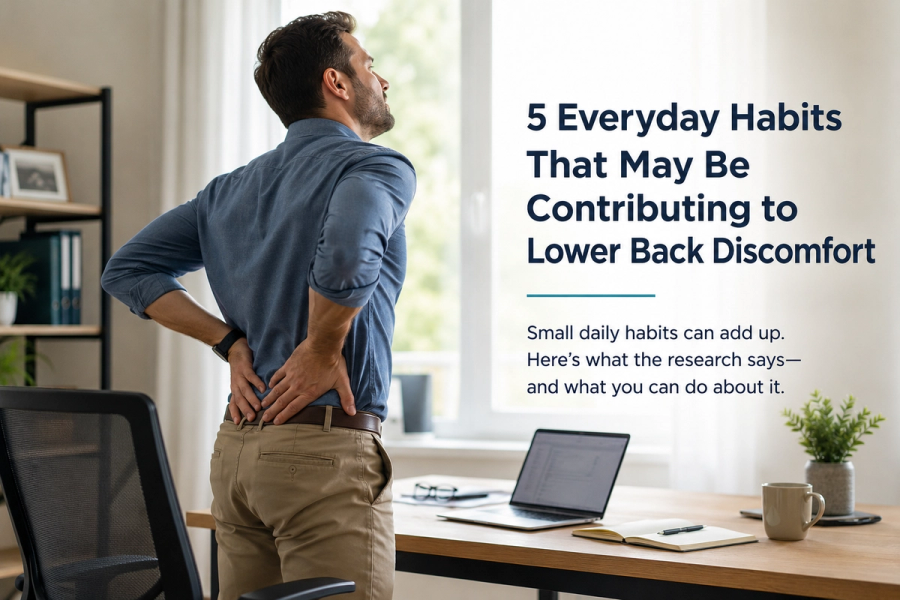
- You Sit Through Meetings, Then Feel Stiff Getting Up
- Life Got Busy, and Somehow You Move Less Than You Used To
- Carrying Groceries or Picking Up Your Kid Leaves You Sore
- Reaching Overhead or Tying Your Shoes Feels Off
- You Wake Up Tight, Even Without Doing Anything Strenuous
- Key Takeaways
- Frequently Asked Questions
- When to Seek Medical Care
If you clicked on this, you're probably not looking for a medical textbook. You're looking for an answer to something like: "Why does my lower back feel this way, and what am I supposed to do about it?"
Here's the short answer up front: for most people, lower back discomfort isn't caused by one bad habit or one wrong move. It's usually a mix of everyday things—how much you sit, how much you move, how you lift, how well you sleep—all adding up over time (Hartvigsen et al., 2018). There's rarely a single culprit, and that's actually good news, because it means there's rarely a single fix either. Instead, there are several small, realistic adjustments that current research links to a lower risk of back trouble. Let's go through them, one real-life situation at a time.
A quick heads-up before we dive in: this article can't diagnose you, and it's not a promise that any of this will erase your discomfort. Everyone's back is different (Hartvigsen et al., 2018). Think of this as a conversation about what tends to help, not a guaranteed fix.
You Sit Through Meetings, Then Feel Stiff Getting Up
Picture this: you've been on back-to-back calls all morning, and when you finally stand up, your lower back feels like it needs a minute to "catch up." Sound familiar?
Why this happens: Your spine and hip muscles aren't built to hold one position for hours. When you stay still for a long time, blood flow slows down and your muscles stiffen up a bit—kind of like a rubber band that's been left folded in one spot. It's less about sitting being "bad" and more about staying frozen in any one position too long.
What the research says: This one might surprise you. Some studies link long sitting hours to more back pain, but others find no clear link at all, especially when sitting isn't combined with other strain like vibration or awkward postures (Hartvigsen et al., 2000; Kwon et al., 2011). A large review of workplace risk factors actually found sitting alone had weaker evidence as a cause of chronic low back pain than things like heavy lifting or twisted postures (Jahn et al., 2023). So sitting may not be the villain we assume it is—staying still for too long, in any position, seems to matter more.
What tends to help: Guidelines from the American College of Physicians and the UK's National Institute for Health and Care Excellence both point toward staying active rather than chasing one "perfect" seated posture (Qaseem et al., 2017; National Institute for Health and Care Excellence [NICE], 2016/2020).
Try This Today: Set a phone reminder for every 45 minutes. When it goes off, just stand up, roll your shoulders, and take 10 steps—even inside a meeting room. That's it.
Everyone's tolerance for sitting is different. Some people can sit for two hours before feeling anything; others notice stiffness after 20 minutes. Neither is wrong—it's just your body.
Life Got Busy, and Somehow You Move Less Than You Used To
Between work, errands, and picking up the kids, you might realize you haven't taken a real walk in days. It's not laziness—it's just how busy life works sometimes.
Why this happens: Your muscles and joints work a bit like tools—they stay "ready" through regular use. When most of your day is spent sitting, driving, or moving between indoor spaces, your body simply gets less practice doing everyday things like bending, twisting, and carrying.
What the research says: This is one of the better-supported pieces of the puzzle. A large analysis of controlled trials found that regular exercise lowered the risk of a low back pain episode by about a third compared to doing nothing, and pairing exercise with basic education lowered it even more (Shiri et al., 2018). A separate review reached a similar conclusion, calling exercise—alone or with education—the most consistently effective strategy for preventing low back pain from starting or coming back (Steffens et al., 2016).
What tends to help: The World Health Organization recommends adults aim for 150–300 minutes of moderate activity a week, plus muscle-strengthening activity twice a week (Bull et al., 2020). That sounds like a lot, but it can be built from small moments.
Try This Today: Take a 10-minute walk after dinner tonight—even around the block. Small, repeated movement tends to matter more than one big workout.
- Take the stairs instead of the elevator when you can
- Park a little farther away
- Do a few minutes of gentle stretching while your coffee brews
Some people feel noticeably better within a couple of weeks of adding movement; for others, it takes longer, or it's one piece of a bigger picture. Both are normal.
Carrying Groceries or Picking Up Your Kid Leaves You Sore
You grab all the grocery bags in one trip to save time. Or you scoop your toddler up out of the car seat while twisting to check on your other kid. A few hours later, your lower back is letting you know about it.
Why this happens: Lifting and carrying put real load through your spine, especially when the load is heavy, held far from your body, or combined with twisting.
What the research says: A large meta-analysis of workplace risk factors found that lifting or carrying loads, along with non-neutral postures like bending and twisting, were among the exposures most strongly linked to chronic low back pain (Jahn et al., 2023). Here's the honest twist, though: the evidence that formal "correct lifting technique" training actually prevents back pain is surprisingly weak. A Cochrane review looked at manual handling training across nearly 20 studies and found moderate-quality evidence that it was no more effective at preventing back pain than no training at all (Verbeek et al., 2011). So there's no single "magic" lifting technique guaranteed to protect you—but reducing unnecessary strain still makes sense based on what we do know about load and posture.
What tends to help:
- Keep the object close to your body instead of reaching for it
- Bend your knees a bit instead of folding forward from your back
- Turn your feet instead of twisting through your spine
- Split heavy loads into two trips when you can
Try This Today: Next time you carry groceries in, do it in two trips instead of one, and notice how much lighter each trip feels on your back.
Some people can lift heavy loads all day with no trouble; others feel it after picking up a light bag. Both are within the range of normal—it doesn't mean something is broken.
Reaching Overhead or Tying Your Shoes Feels Off
You bend down to tie your shoelaces and feel it more in your lower back than your legs. Or you reach for something on a high shelf and your back seems to be doing the work your shoulder should be doing.
Why this happens: Your hips and upper back are supposed to handle a lot of the bending, twisting, and reaching you do all day. The idea is that when those areas get stiff, your lower back may pick up some of the slack—a concept sometimes called "regional interdependence" in physical therapy (Wainner et al., 2007).
What the research says: Here's where we need to be honest about uncertainty. A systematic review looking specifically at hip motion and low back pain found only very low-quality evidence connecting the two, with limited hip rotation being the one measurement that showed a possible—but far from certain—link (Avman et al., 2019). In other words, this is a reasonable, widely used clinical idea, but it's not yet backed by strong research. It's worth holding loosely rather than treating as settled fact.
What tends to help: Because the direct evidence here is thin, the safest bet is folding hip and upper-back movement into the broader, better-supported habit of regular activity (Shiri et al., 2018; Bull et al., 2020).
Try This Today: While brushing your teeth, do 10 slow hip circles in each direction. It takes 30 seconds and costs you nothing.
- Gentle hip stretches a few times a week
- Slow upper-back rotations (think: turning to check your blind spot, but exaggerated)
- Getting in and out of the car by pivoting your whole body, not just twisting your spine
Some people notice a difference from mobility work; others don't feel much change at all. That doesn't mean it isn't worth doing—it just means results vary.
You Wake Up Tight, Even Without Doing Anything Strenuous
You didn't garden, you didn't move furniture, you just... woke up stiff. It can feel confusing when there's no obvious cause.
Why this happens: Recovery isn't just about your muscles—it's also about sleep and stress. When your body doesn't get enough rest, or when you're constantly stressed, it doesn't get the same chance to reset.
What the research says: A large study of hospital workers found that both higher stress and higher pain intensity were independently linked to poorer sleep quality (Vinstrup et al., 2018). A systematic review focused on chronic spinal pain found weak-to-moderate evidence connecting poorer sleep with more intense pain—and the relationship likely runs both ways: poor sleep can make pain feel worse, and pain can disrupt sleep in return (Van Looveren et al., 2021). Some longer-term research also suggests that a decline in sleep quality over time is linked to a higher chance of developing a pain condition later (Afolalu et al., 2018).
What tends to help:
- Aim for a consistent bedtime, even 20 minutes earlier than usual
- Take a few minutes to decompress during a stressful day—a short walk, deep breaths, stepping outside
- Notice when you're pushing through exhaustion instead of listening to it
Try This Today: Tonight, put your phone away 15 minutes earlier than usual and notice how your body feels tomorrow morning.
Sleep and stress affect everyone differently. Some people are highly sensitive to a bad night's sleep; others barely notice. Neither response is unusual.
Key Takeaways
- Lower back discomfort is rarely caused by one single habit, movement, or posture—it's usually a mix of factors (Hartvigsen et al., 2018).
- Prolonged sitting has weaker evidence as a direct cause of back pain than many people assume; staying in any one position too long seems to matter more (Jahn et al., 2023).
- Regular movement and exercise currently have some of the strongest supporting evidence for reducing back pain risk (Shiri et al., 2018; Steffens et al., 2016).
- "Correct lifting technique" training hasn't been shown to reliably prevent back pain, though reducing unnecessary strain still makes practical sense (Verbeek et al., 2011).
- The link between hip/upper-back stiffness and low back pain is a reasonable idea but currently backed by only low-quality evidence (Avman et al., 2019).
- Sleep and stress are genuinely connected to how your back feels, in both directions (Vinstrup et al., 2018; Van Looveren et al., 2021).
- Small, consistent changes matter more than one perfect fix—and everyone's experience is different.
Frequently Asked Questions
1. Is sitting really that bad for my back? Not necessarily. Some research links long sitting to back discomfort, but other studies find no clear connection, especially when sitting isn't combined with other strain (Hartvigsen et al., 2000; Jahn et al., 2023). Staying in one position too long—seated or otherwise—appears to matter more than sitting itself.
2. What's the "correct" way to lift heavy things? There's no single technique proven to prevent back pain (Verbeek et al., 2011), but keeping loads close to your body, bending your knees, and avoiding twisting while lifting are reasonable, low-risk habits.
3. Will stretching my hips fix my lower back pain? It might help some people, but the direct evidence connecting hip mobility to low back pain is currently low quality (Avman et al., 2019). It's a reasonable thing to try, not a guaranteed solution.
4. How much exercise do I actually need? Current guidelines suggest 150–300 minutes of moderate activity a week for adults, along with muscle-strengthening activity twice a week (Bull et al., 2020). This can be broken into small chunks throughout your week.
5. Can poor sleep really affect my back pain? Yes, there's a real, documented connection—though it runs in both directions and isn't fully understood yet (Vinstrup et al., 2018; Van Looveren et al., 2021).
When to Seek Medical Care
This article is meant for general education, not diagnosis. Please check in with a doctor, physical therapist, or other qualified healthcare provider if you experience:
- Back pain that doesn't improve after a few weeks
- Pain that's severe, sudden, or getting worse
- Numbness, tingling, or weakness in your legs
- Pain following a fall, accident, or injury
- Unexplained weight loss along with back pain
- Loss of bladder or bowel control (seek care immediately)
Clinical guidelines recommend individualized assessment for persistent or concerning symptoms rather than self-managing indefinitely (NICE, 2016/2020; Qaseem et al., 2017).
References
- Afolalu, E. F., Ramlee, F., & Tang, N. K. Y. (2018). Effects of sleep changes on pain-related health outcomes in the general population: A systematic review of longitudinal studies with exploratory meta-analysis. Sleep Medicine Reviews, 39, 82–97. https://doi.org/10.1016/j.smrv.2017.08.001
- Avman, M. A., Osmotherly, P. G., Snodgrass, S., & Rivett, D. A. (2019). Is there an association between hip range of motion and nonspecific low back pain? A systematic review. Musculoskeletal Science and Practice, 42, 38–51.
- Bull, F. C., Al-Ansari, S. S., Biddle, S., Borodulin, K., Buman, M. P., Cardon, G., Carty, C., Chaput, J.-P., Chastin, S., Chou, R., Dempsey, P. C., DiPietro, L., Ekelund, U., Firth, J., Friedenreich, C. M., Garcia, L., Gichu, M., Jago, R., Katzmarzyk, P. T., … Willumsen, J. F. (2020). World Health Organization 2020 guidelines on physical activity and sedentary behaviour. British Journal of Sports Medicine, 54(24), 1451–1462.
- Hartvigsen, J., Leboeuf-Yde, C., Lings, S., & Corder, E. H. (2000). Is sitting-while-at-work associated with low back pain? A systematic, critical literature review. Scandinavian Journal of Public Health, 28(3), 230–239.
- Hartvigsen, J., Hancock, M. J., Kongsted, A., Louw, Q., Ferreira, M. L., Genevay, S., Hoy, D., Karppinen, J., Pransky, G., Sieper, J., Smeets, R. J., Underwood, M., & Lancet Low Back Pain Series Working Group. (2018). What low back pain is and why we need to pay attention. The Lancet, 391(10137), 2356–2367.
- Jahn, A., Andersen, J. H., Christiansen, D. H., Seidler, A., & Dalbøge, A. (2023). Occupational mechanical exposures as risk factor for chronic low-back pain: A systematic review and meta-analysis. Scandinavian Journal of Work, Environment & Health, 49(7), 453–465.
- Kwon, B. K., Roffey, D. M., Bishop, P. B., Dagenais, S., & Wai, E. K. (2011). Systematic review: Occupational physical activity and low back pain. Occupational Medicine, 61(8), 541–548.
- National Institute for Health and Care Excellence. (2020). Low back pain and sciatica in over 16s: Assessment and management (NICE Guideline NG59). (Original work published 2016).
- Qaseem, A., Wilt, T. J., McLean, R. M., Forciea, M. A., & Clinical Guidelines Committee of the American College of Physicians. (2017). Noninvasive treatments for acute, subacute, and chronic low back pain: A clinical practice guideline from the American College of Physicians. Annals of Internal Medicine, 166(7), 514–530.
- Shiri, R., Coggon, D., & Falah-Hassani, K. (2018). Exercise for the prevention of low back pain: Systematic review and meta-analysis of controlled trials. American Journal of Epidemiology, 187(5), 1093–1101.
- Steffens, D., Maher, C. G., Pereira, L. S. M., Stevens, M. L., Oliveira, V. C., Chapple, M., Teixeira-Salmela, L. F., & Hancock, M. J. (2016). Prevention of low back pain: A systematic review and meta-analysis. JAMA Internal Medicine, 176(2), 199–208.
- Van Looveren, E., Bilterys, T., Munneke, W., Cagnie, B., Ickmans, K., Mairesse, O., Malfliet, A., De Baets, L., Nijs, J., Goubert, D., Danneels, L., Moens, M., & Meeus, M. (2021). The association between sleep and chronic spinal pain: A systematic review from the last decade. Journal of Clinical Medicine, 10(17), 3836.
- Vinstrup, J., Jakobsen, M. D., Calatayud, J., Jay, K., & Andersen, L. L. (2018). Association of stress and musculoskeletal pain with poor sleep: Cross-sectional study among 3,600 hospital workers. Frontiers in Neurology, 9, Article 968. https://doi.org/10.3389/fneur.2018.00968
- Wainner, R. S., Whitman, J. M., Cleland, J. A., & Flynn, T. W. (2007). Regional interdependence: A musculoskeletal examination model whose time has come. Journal of Orthopaedic & Sports Physical Therapy, 37(11), 658–660.
Schedule a 15-minute discovery consultation.
Book a 15-Minute Discovery Consultation